
In concrete and infrastructure engineering, coarse aggregate and fine aggregate are core basic building materials that directly determine the strength, compactness and service life of concrete. High-quality coarse aggregate and fine aggregate must strictly comply with national and international standards. They are the core production indicators of sand and stone production lines. Controlling the production parameters of the two aggregates effectively improves construction quality from the source.
一. Particle Size Classification Standards
First of all, particle size is the core basis for distinguishing coarse aggregate and fine aggregate, with clear definitions in domestic and international industry standards.
Fine aggregate refers to sand particles with a nominal particle size of 0.16mm to 4.75mm, mainly including natural sand and manufactured sand with fine and uniform particles.
Coarse aggregate refers to hard particles with a nominal particle size larger than 4.75mm. Crushed stone and pebbles are common types that offer high hardness and strong support performance.
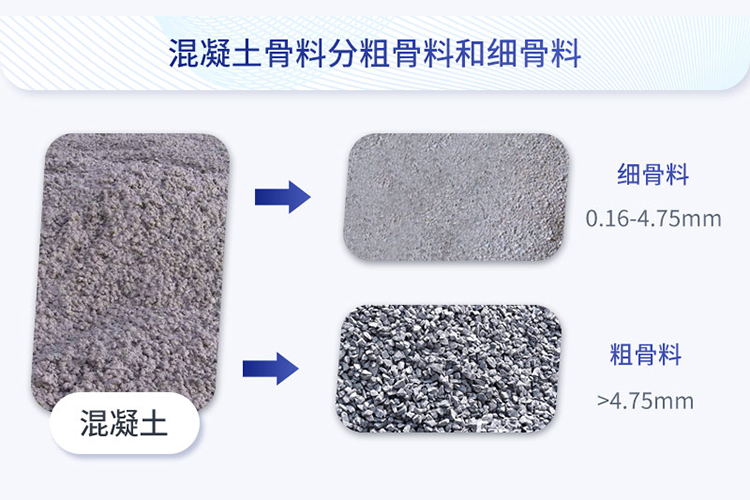
Fine Aggregate—Sand
Aggregates with a particle size of less than 4.75 mm are classified as fine aggregates, also known as sand. Common types of fine aggregates include coarse sand, medium sand, fine sand, and extra-fine sand. Coarse and medium sand are used in concrete, while fine sand is used for plastering and grouting; medium sand is generally the most suitable choice for ordinary concrete.
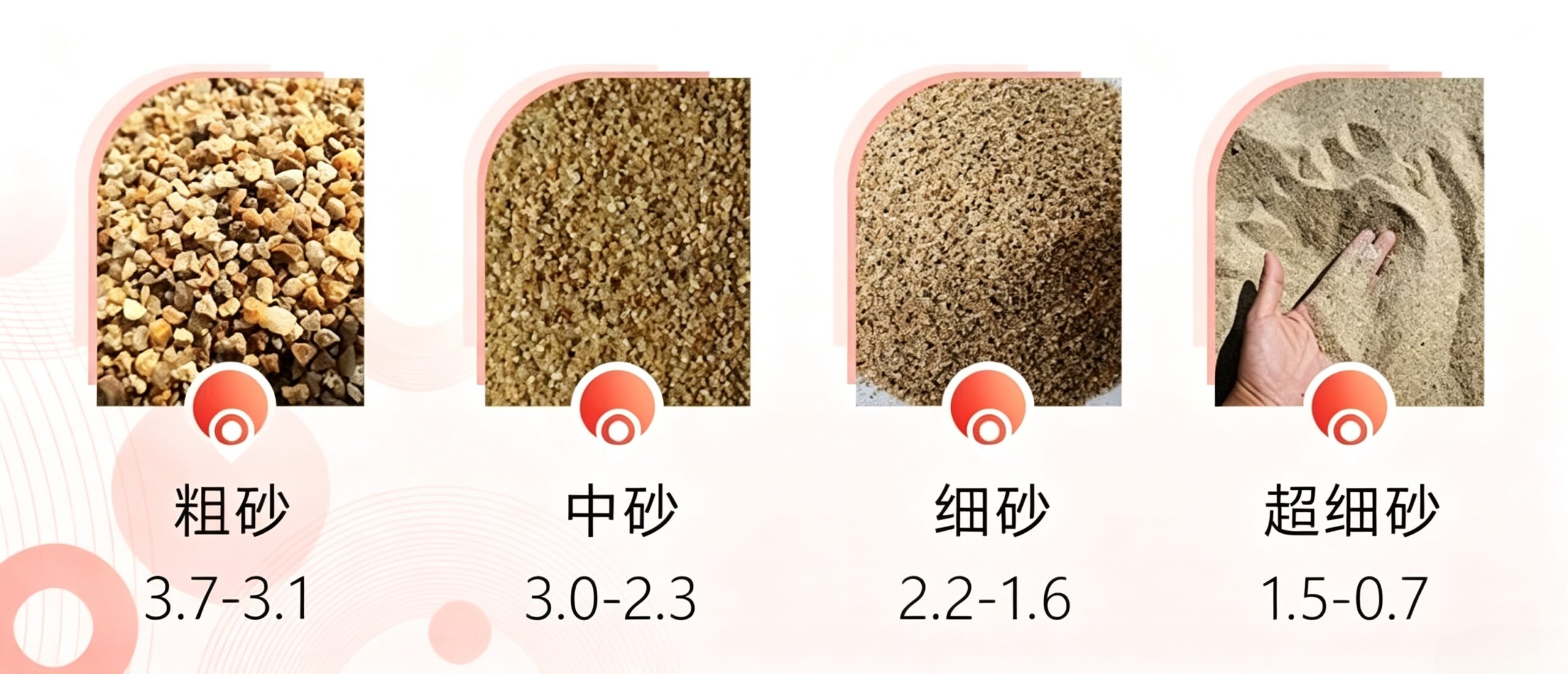
Sand Particle Size and Fineness Grade:
(1) Coarse sand: Fineness modulus 3.7–3.1;
traditional textbooks reference an average particle size of >0.5 mm; commonly known in the market as “coarse sand” or “05 sand.”
(2) Medium sand: Fineness modulus 3.0–2.3;
traditional textbooks reference an average particle size of 0.35–0.5 mm.
(3) Fine sand: Fineness modulus 2.2–1.6;
traditional textbooks cite an average particle size of 0.25–0.35 mm; commonly known in the market as “face sand.”
(4) Extra-fine sand: Fineness modulus 1.5–0.7;
traditional textbooks cite an average particle size of <0.25 mm.
Coarse Aggregate—Gravel
Aggregates with a particle size greater than 4.75 mm are classified as coarse aggregates, also known as gravel, and are generally categorized as 5-1 gravel, 1-2 gravel, 1-3 gravel, 2-4 gravel, and 4-6 gravel.
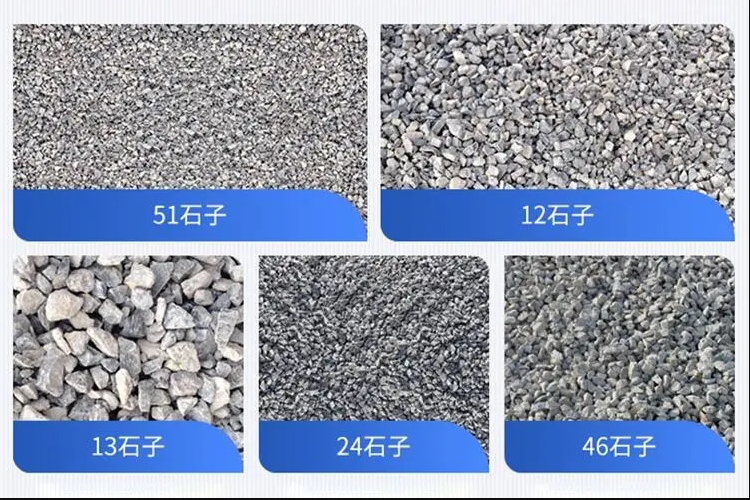
(1) 5-1 Gravel
Refers to crushed stone with a particle size of 5–10 mm, commonly known as “melon seed gravel.”
(2) 1-2 Gravel
Refers to crushed stone with a particle size of 10–20 mm, commonly used in road surface layers and concrete.
(3) 1-3 Gravel
Refers to crushed stone with a particle size of 16–31.5 mm.
(4) 2-4 Gravel
Refers to “2-4 fen”; the international standard is 1/4–1/2 inch (6.35‑12.7 mm), with a particle size of 10–15 mm.
(5) 4-6 Gravel
Refers to “4-6 fen”; the international standard is 1/2–3/4 inch (12.7‑19.05 mm), with a particle size of 15–20 mm.
Note: 5-1, 1-2, 1-3, 2-4, and 4-6 are colloquial industry terms; formal technical documents should use the nominal particle size designations specified in national standards.
二. Engineering Application Scenarios
Coarse aggregate is widely used in load-bearing structural projects such as high-rise building beams and columns, bridges, road subgrades and large equipment foundations to ensure overall structural stability.
Fine aggregate is mainly used in fine construction scenarios such as wall masonry mortar, wall plastering, floor surface and fine stone concrete to optimize construction flatness and bonding strength.
Lastly, as professional aggregate production lines can accurately control aggregate particle size, shape and cleanliness, they mass-produce standardized coarse aggregate and fine aggregate.
Our complete set of crushing, screening and sand-making equipment flexibly adjusts production parameters and strictly controls aggregate mud content and flaky particle content to ensure finished aggregates meet domestic and foreign construction standards. Whether you choose fixed or mobile models, production lines achieve precise graded production of coarse aggregate and fine aggregate. Professional aggregate processing equipment is the key to producing high-quality coarse aggregate and fine aggregate and guaranteeing project quality.
 whatsApp